How deep do deck footings need to be?
The same deck needs a 12-inch footing in Atlanta and a 48-inch one in Boston. We compared the required depth across 20 U.S. cities — the ground, not the deck, decides.
The short answer
A deck footing has to reach below the frost line — the depth to which the ground freezes in winter — and never less than 12 inches.
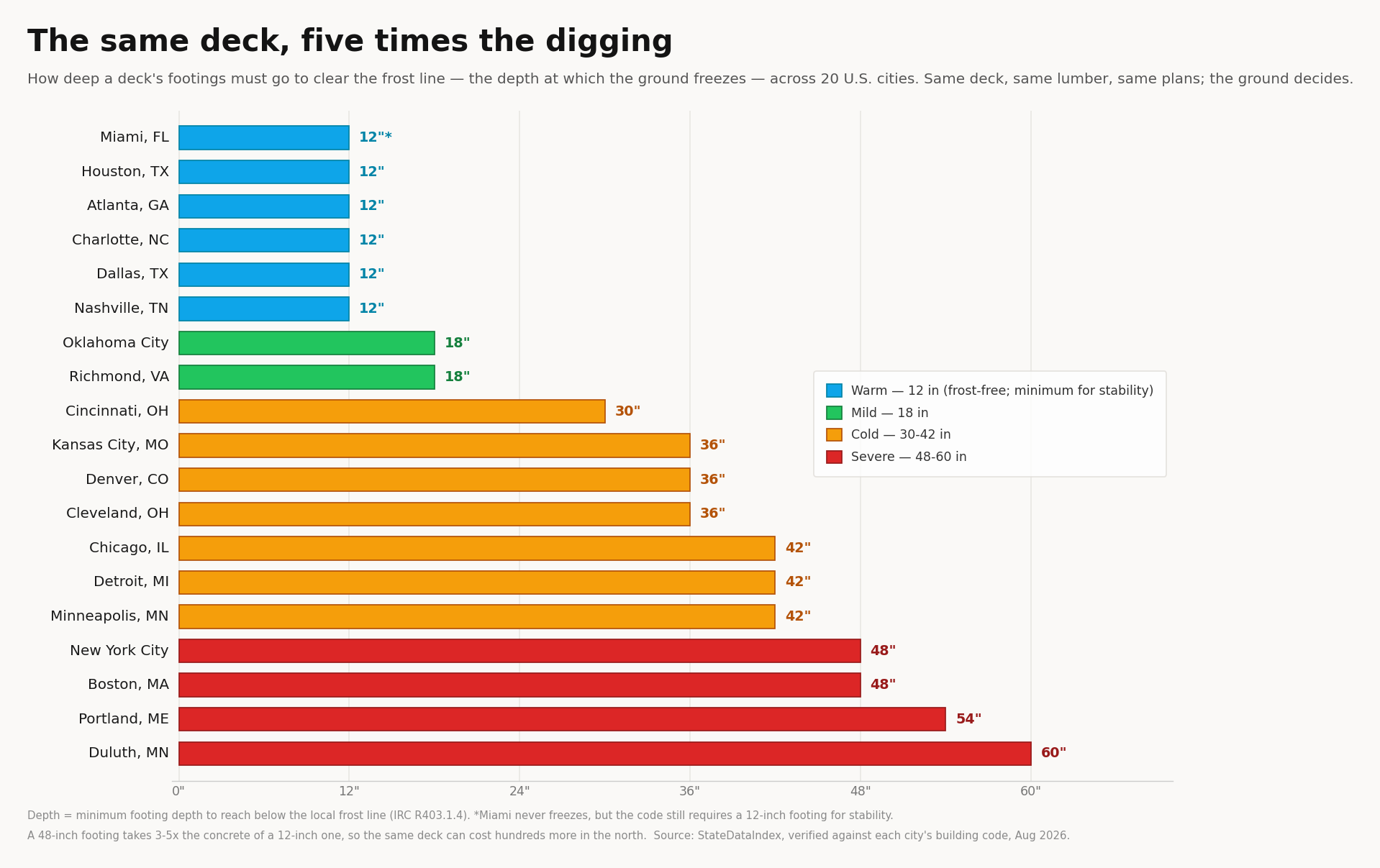
That single rule, from Section R403.1.4 of the International Residential Code, produces wildly different holes depending on where you dig. In frost-free Florida a footing goes down about 12 inches, just enough to reach stable soil. In Boston it goes down 48 inches. In northern Minnesota, 60. The deck on top can be identical; the foundation underneath it is a different project entirely.
The reason is a force called frost heave. When water in the soil freezes it expands about 9 percent, and that expansion pushes upward with enough force to lift a footing several inches. A footing that bears below the frost line rests on soil that never freezes, so it stays put. A footing that stops short heaves every winter and settles every spring, and over a few seasons it cracks the concrete, knocks the posts out of plumb, and pulls the ledger board off the house.
What we found
Required deck footing depth by city
Here are 20 U.S. cities from shallowest to deepest, each figure taken from that city's or state's own building code. The color band groups them by climate severity.
| City | State | Footing depth | Code source |
|---|---|---|---|
| Miami | FL | 12 in* | FL Building Code (frost-free; 12 in for stability) |
| Houston | TX | 12 in | IRC R403.1.4 (frost-free) |
| Atlanta | GA | 12 in | GA State Min. Standard Code, R403.1.4 |
| Charlotte | NC | 12 in | 2018 NC Residential Code, Table R301.2(1) |
| Dallas | TX | 12 in | TX / IRC R403.1.4 |
| Nashville | TN | 12 in | Davidson County local amendment, Table R301.2(1) |
| Oklahoma City | OK | 18 in | Local amendment to IRC Table R301.2(1) |
| Richmond | VA | 18 in | Central VA frost line, Table R301.2(1) |
| Cincinnati | OH | 30 in | City of Cincinnati Deck Plan |
| Kansas City | MO | 36 in | KC Code of Ordinances, Ch. 18, Sec. 18-57 |
| Columbus | OH | 32 in | Columbus City Codes 4125.03 |
| Denver | CO | 36 in | 2022 Denver Building Code, 1809.5 |
| Cleveland | OH | 36 in | Cleveland Code of Ordinances 3125.06 |
| Chicago | IL | 42 in | 2019 Chicago Building Code, 1809.5 |
| Detroit | MI | 42 in | Detroit City Residential Code 2019 |
| Minneapolis | MN | 42 in | MN Rules 1303.1600 (Zone 2) |
| New York City | NY | 48 in | 2022 NYC Construction Codes, 1809.3.1 |
| Boston | MA | 48 in | 780 CMR, Table R301.2(1) |
| Portland | ME | 54 in | Maine / city deck guidelines |
| Duluth | MN | 60 in | MN Rules 1303.1600 (Zone 1) |
*Miami never freezes, but the code still requires a 12-inch footing for stability. Best practice is to set the footing bottom about 6 inches below the published frost line. Confirm the exact figure with your local building department before you dig.
Even one state moves the goalposts
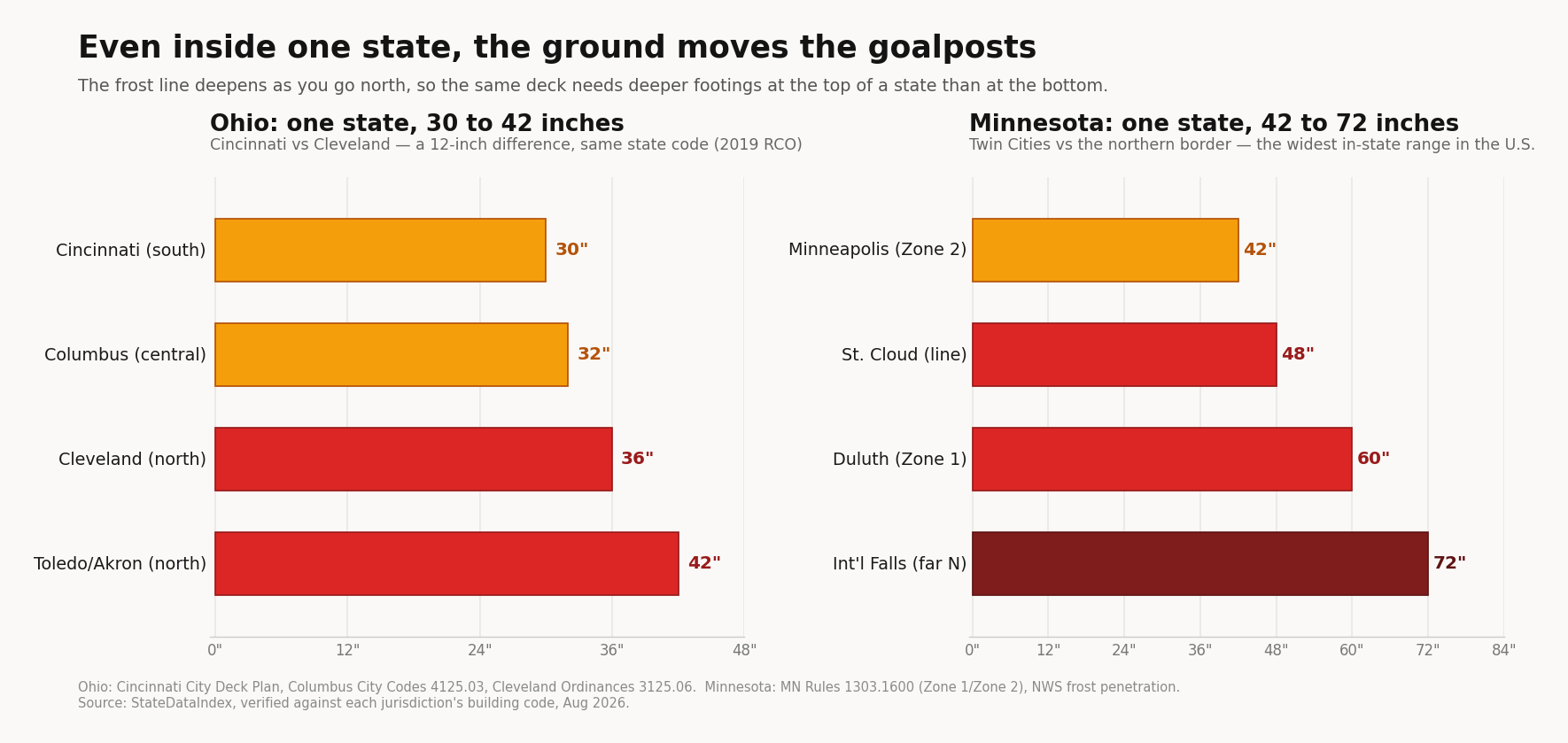
The frost line doesn't stop at the state line — it deepens steadily as you go north, so a single state can span a huge range. Ohio and Minnesota are the clearest examples: the same deck needs a much deeper footing at the top of the state than at the bottom.
Colorado adds a twist that latitude alone can't explain: elevation. Denver, at 5,280 feet, uses a 36-inch frost depth, but mountain towns like Breckenridge and Telluride regularly require 48 to 60 inches. In Colorado, how high you are matters more than how far north.
What the depth costs you
A deeper footing isn't just a deeper hole — it's more excavation, more concrete, and longer posts, on every single footing. The difference adds up fast.
The northern premium
- A 12-inch footing takes roughly 2 cubic feet of concrete; a 48-inch footing takes three to five times as much.
- Across a typical deck with six to eight footings, the jump from a 12-inch city (Savannah) to a 48-inch city (Boston) can add $300 to $800 to the foundation alone — about $50 to $100 per footing.
- Deep-frost regions (48–72 in) often switch to helical steel piers screwed below the frost line instead of poured tube footings, changing the whole method.
- Northern decks also carry a snow-load design requirement that southern decks skip entirely, which can drive up beam and joist sizing on top of the footing cost.
The extreme: where footings stop working
The deepest requirement in the country is in Alaska, and it breaks the pattern. Anchorage requires cast-in-place concrete piers to reach 120 inches — ten feet — reducible to 60 inches only in soils proven not to be frost-susceptible. Fairbanks requires 42 inches; Juneau, 32.
But in the permafrost that underlies much of interior Alaska, the whole idea of a below-frost footing falls apart. The ground is permanently frozen, and disturbing it with a traditional footing can thaw it, causing the soil to collapse and the structure to sink. Decks there rest on driven piles that reach stable frozen ground, or on adjustable systems and thermosyphons that actively pull heat out of the soil to keep it frozen. It's the one place where digging deeper is exactly the wrong answer.
Find your county's deck rule
Footing depth is set locally, and the only authoritative number is your building department's. Find your state, pick your county, and get the verified deck rule plus the local building department's contact details before you build.
Find your county's deck permit rule
We track permit rules and building-department contacts for 3,000+ U.S. counties across all 50 states.
Find your state's directory →How we did this & sources
This analysis is based on StateDataIndex's database of residential building rules. For this study we compiled the required minimum deck footing depth for 20 U.S. cities and verified each against a primary source — the city or state building code, ordinance, or building-department guidance. Anchor figures were confirmed against the actual code text, including Minnesota Rules 1303.1600, the 2019 Chicago Building Code (1809.5), the Detroit City Residential Code, the Massachusetts State Building Code 780 CMR, and the Columbus and Cleveland municipal codes.
Footing depth is governed by Section R403.1.4 of the International Residential Code, which requires footings to bear the greater of 12 inches or below the local frost line set in Table R301.2(1). Frost depth varies within a state by latitude, elevation, and soil, so the city figures here are the prevailing design values, not the number for every address. Building departments set the authoritative figure, and code editions change — this study is general guidance, not engineering or legal advice. Always confirm with your local building department before you build.
Questions or a correction? Email hello@statedataindex.com.
Use this data
Free to cite & republish
Journalists and writers are welcome to use these findings and the table, with a link back to the source. Suggested attribution:
Source: StateDataIndex — "How Deep Do Deck Footings Need to Be? (2026)" — https://statedataindex.com/studies/deck-footing-depth-by-city